


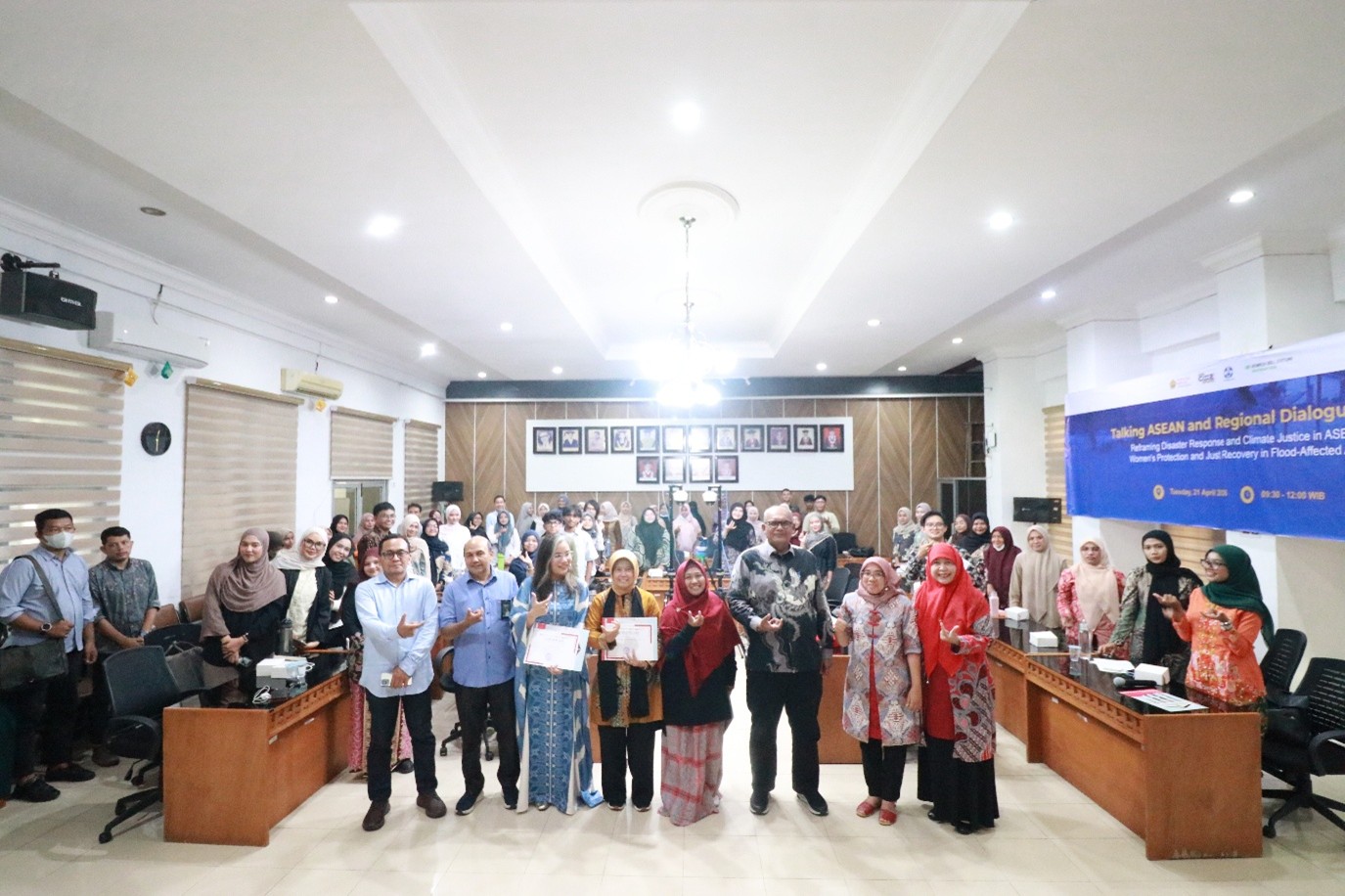
The convergence of Kartini Day and Earth Day this year was marked by a profound intellectual and strategic gathering at Law Faculty, Universitas Syiah Kuala. The Regional Dialogue, titled “Talking ASEAN: Reframing Disaster Response and Climate Justice in ASEAN: Women’s Protection and Just Recovery in Flood-Affected Aceh,” held on Tuesday (21/04) in Banda Aceh, provided a critical platform for the Faculty of Law, Aceh Climate Change Research Center (ACCRC), The Habibie Center, and Heinrich Böll Stiftung (hbs) Southeast Asia. Together, they moved beyond traditional discourse to dissect the complex layers of women’s protection amidst the increasing frequency of climate-induced flooding across the Aceh region.
The event reached a strategic milestone with the formal signing of a Memorandum of Agreement (MoA) and a placard exchange at the opening ceremony. Represented by the Dean of Law Faculty, Prof. Dr. Ilyas, S.H., M.Hum., and the Director of Programs and Development of The Habibie Center, Dr. Julia Novrita, this partnership solidifies a long-term commitment to inclusive legal scholarship. The Dean of Law Faculty underscored that this synergy is a cornerstone for the faculty’s mission to produce legal frameworks that are not gender-neutral, but gender-responsive. He then asserted that the law must evolve to ensure that women are not merely recipients of aid, but active architects of disaster mitigation and climate policy, ensuring their voices are woven into the very fabric of regional governance.
The dialogue was set against the backdrop of a poignant documentary screening that laid bare the systemic failures in current disaster management. Responding to these visual testimonies, Dr. June Mary Rubis, an expert from Sarawak, Malaysia, delivered a stirring call to action. Addressing the hall filled with law students, she framed them as the “future administrators of change”, the next generation of lawmakers, diplomats, and ambassadors. Dr. June highlighted that Aceh, given its historic resilience following the 2004 tsunami, holds a unique moral authority to lead ASEAN. She argued that true climate justice requires a departure from “top-down” approaches, urging the integration of indigenous knowledge and local wisdom that has allowed communities to coexist with their environment for generations.
The gravity of the situation was further illuminated by Ir. Suraiya Kamaruzzaman, S.T., M.T., who presented data-driven evidence of the “shadow crisis” following floods. She noted that while women are instinctively the first responders in their neighborhoods, often being the ones to secure the safety of children and the elderly, they remain marginalized in the aftermath. Her presentation highlighted a staggering 76% global figure regarding “unpaid care work,” a burden that intensifies during disasters as women manage household recovery with limited access to clean water or early warning information. This structural invisibility means that despite their leadership at the grassroots level, women’s specific needs and insights are frequently absent from formal legal recognition and recovery budgets.
Expanding on this reality, Rahmiana Rahman, M.Pd., shared harrowing accounts from affected villages such as those in Aceh Tamiang and Nagan Raya. She described the loss of community anchors like the Pustaka Gampong Impian and emphasized that current disaster infrastructure fails to provide safe, dignified spaces for women, particularly regarding sanitation and reproductive health. Turning toward the regional horizon, Dr. Debbie Affianty detailed the transformative shift in the ASEAN 2026-2030 vision. She explained that the region is moving away from seeing women as “vulnerable objects” toward recognizing them as “transformative agents.” This shift is crucial for climate justice, ensuring that women have a decisive seat at the law-making table rather than being consulted only after policies are finalized.
The dialogue concluded not just as a discussion, but as a collective pledge to elevate the lived experiences of Acehnese women to the global stage. By bridging the gap between local grassroots realities and regional ASEAN policy-making, the collaborators aimed to foster a “just recovery.” This vision for the future focuses on restoring not only physical infrastructure but also the dignity and rights of women, ensuring that the legal and social systems of tomorrow are resilient, inclusive, and capable of protecting the most marginalized against the escalating threats of a changing climate.
Comments are closed